A medicine student, currently in her 5th year of university, has been requested by Student Finance England to repay £1,500 of her student loan.
Whilst in her 4th year of education, Hannah Nolan, student at Newcastle University, was asked to pay part of her maintenance loan back to SFE due to a change in her fathers financial circumstances. Before the beginning of the academic year, she filed out her current income assessment in line with her fathers earnings, however, with this improving over the year, she has been asked to pay back a portion of that loan.
Hannah, who started her medicine degree in 2020, is currently intercalating doing a masters in global health, and will finish her university degree after she has completed her final year of medicine in 2026. She spoke to me about her experiences with student finances and the difficulties of getting funding whilst doing medicine.
Medicine students in England can only receive student finance up until the end of their 4th year of university education. After this point, they rely on NHS funding to cover the rest of their degree in terms of maintenance loans and the cover tuition fees. Students who go straight into 5th year medicine can qualify for £1000 to £2000 from student finance and up to £5000 from the NHS bursary, which means that students can get a maximum of £7000 to a minimum of £2000.
“The NHS bursary is means tested and the most I’ve heard someone getting is £4,000”.
As Hannah is intercalating, she does not receive any support from student finance.
She noted that the lack of financial support has affected a lot of medicine students who are on the minimum student loan have had to rely more heavily on their parents or other financial means for support.
“I am very lucky that my uncle sends me £200 a month to help with living costs but with rent being £520 a month, without the bursary I received I would be a few grand off even covering my rent”
Alongside her full-time masters degree, Hannah has to work at least 15 hours a week in order to cover all of her costs which she has said has had a toll on her student experience, making taking part in student life more difficult and affecting how much she can study. Without the security of a student loan, she said she has “definitely experienced financial difficulty”.
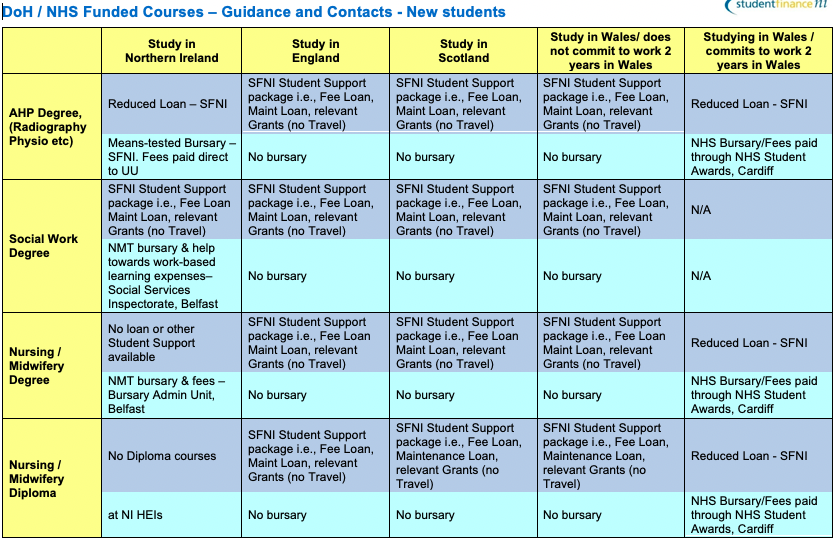
The NHS website states that students might be eligible for funding, and the amount or timing given depends on the type of course each student has chosen to do. For the NHS bursary to apply, the NHS website states that individuals need to be be an English resident living in England. Students from elsewhere in the UK need to work with their own student finance schemes to apply for extra financial support.
As student finance works differently in different parts of the UK, students from Northern Ireland studying in England cannot receive any additional NHS bursary support, making it that much harder for them to get through medical school. Northern Irish students do not qualify for the NHS bursary unless they are studying in Northern Ireland, meaning that they have to externally source income to cover living costs if they are studying elsewhere in the UK.
Medicine students who need to repeat a year can be eligible for an additional 12 months NHS bursary, however, this only applies to students in their 5th and 6th years of medicine.
Leave a Reply