

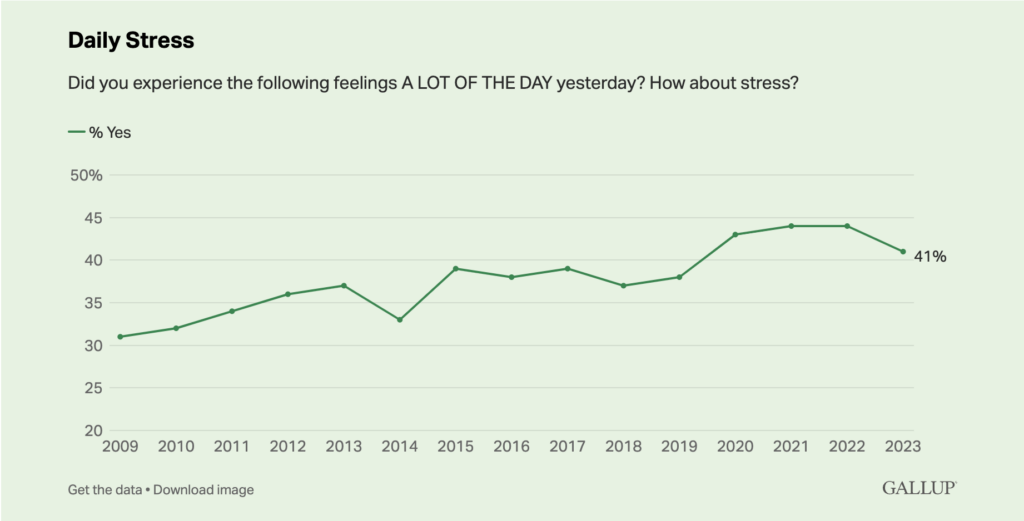
“People’s mental health has been getting worse. Over the past 10 years, the number of people expressing stress, sadness, anxiety, anger or worry has been increasing”. – 2023/2024 Human Development Report, United Nations Development Programme. According to Gallup survey data, in 2023, 41% of respondents said they felt “very much stress” the day before. Although this proportion is slightly lower than the peak in previous years, it is still at a significantly high level.
credit: GALLUP
Rising stress levels are increasingly affecting employees’ mental health, prompting many to rethink their career choices. As a result, mental health support has become a crucial factor in deciding where to work.

credit: Lei Xiao
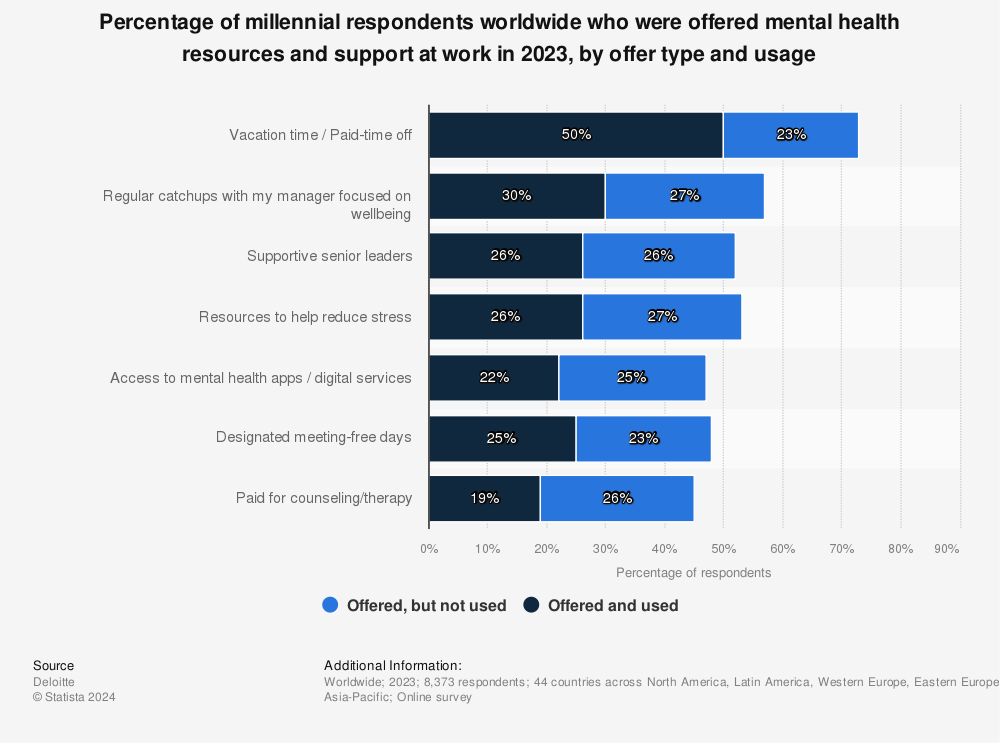
A 2023 report found that over half of millennial employees (50%) received mental health support measures, such as paid leave or flexible working hours. Additionally, 27% had access to stress relief resources, 26% received support from senior leaders, and nearly a quarter had access to mental health apps or digital services.
credit: Statista
“Companies are increasingly aware of the important impact of employee mental health on work efficiency and performance,” said Xu Sihua, a psychology expert. “Providing flexible work schedules, professional consulting services and digital assistance tools can help employees relieve stress and maintain mental health.”
Despite many companies offering mental health support, a large number of employees are not fully utilizing these resources. Nearly one-third of millennials report that, although support is available, they don’t actually use it, indicating the need for a workplace culture that encourages participation and reduces stigma around mental health.
“Our company has really increased its focus on employee mental health over the past two years,” said an employee of Deloitte. “In addition to providing more welfare support, management has also begun to pay attention to creating a more inclusive and understanding work culture. But I think there is still room for improvement, such as making support measures more relevant to actual needs and eliminating employees’ concerns about seeking help.”
As companies pay more and more attention to the mental health of their employees, experts suggest that in addition to providing basic mental health support services, companies should also consider how to more effectively integrate these measures into daily work. Xu Sihua pointed out: “It is not enough to simply provide mental health resources. The key is how to make these resources truly used by employees and how to overcome employees’ concerns about using these resources.”

credit: Yin Zhu
In order to more fully explore how mental health affects career choices, we heard from Newcastle residents’:
credit: Yin Zhu
This street interview revealed that mental health is increasingly influencing career decisions, with many reconsidering their jobs when faced with overwhelming stress. It’s clear that mental health is now a key factor in career choices, no longer something to be overlooked.
The statistics provided to back up the claims are well researched and well received