
Recently, the International Labor Organization released its 2024 Global Youth Employment Trends report. The report highlights that while youth employment has improved since the early 21st century, significant challenges still remain. In highly competitive fields, educational background often determines the fairness of job opportunities, leading to increased concerns among young people about career stability and economic prospects.
And we can see that from a Chinese job search platform, there are always educational requirements for some positions, like undergraduate, master and etc.
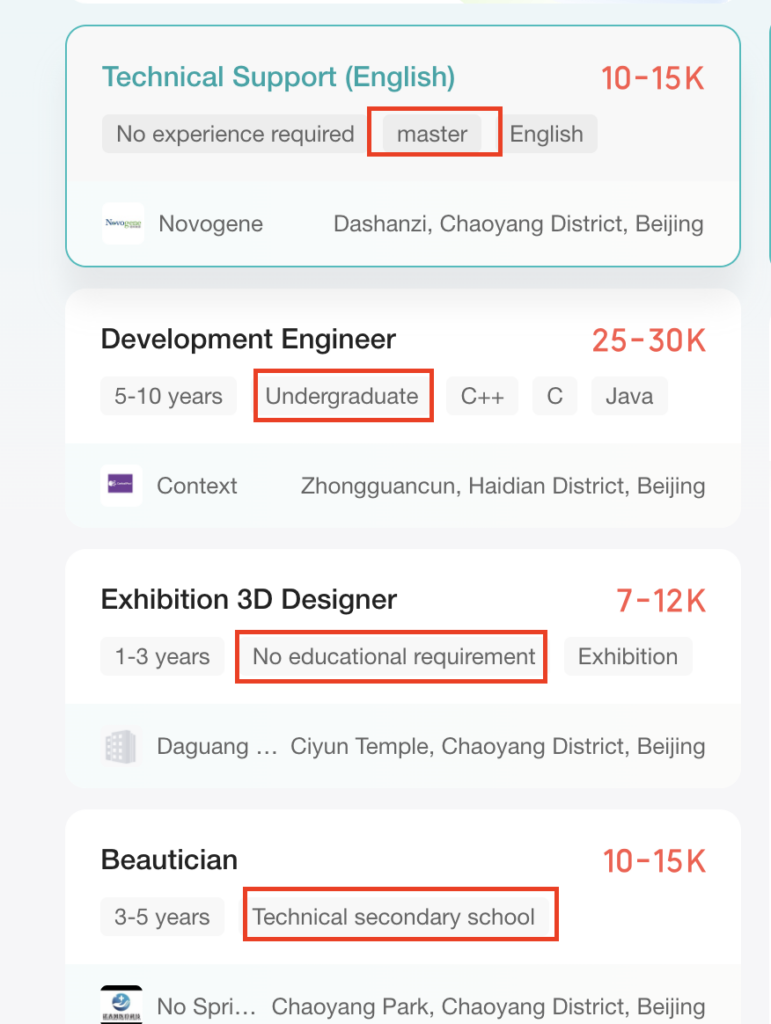
credit: Chinese job search platform
When it comes to the relationship between educational background and actual work ability, as well as how these factors influence hiring decisions, Xuan Yu, a human resources expert working in a Chinese company for over three years, shared her insights:
“I think both educational background and work ability are important, but for different reasons. Education provides a solid foundation… but actual work ability—like problem-solving, adaptability, and people skills—really shows how someone can use that knowledge in real life.”
She also noted the evolving expectations in today’s job market: “Employers are increasingly looking for candidates who not only have the necessary qualifications but who also demonstrate a willingness to learn and adapt. Continuous learning and professional development have become key factors in standing out.”
In terms of balancing these factors in hiring decisions:
“When I’m making hiring decisions, I try to look at the whole picture. Sure, a strong educational background is great, but I also pay close attention to practical experience… In some cases, experience or proven skills can matter more than a formal degree. In the end, it’s all about finding the right fit for the role and the company, so I consider both education and real-world ability.”
She emphasized, “It’s not just about what you know when you graduate, but how you continue to grow and apply that knowledge throughout your career. Companies are looking for that balance—someone who brings both academic knowledge and real-world experience to the table.”
Xuan Yu
For another perspective, recent graduate Yuting Zeng who’s just starting out in the job market, shared her story:
credit: Yin Zhu
These insights highlight just how important the balance between education and work skills is in today’s job market. When employers and job seekers understand and manage these factors well, they’re much better equipped to handle the challenges of a competitive job landscape.