
When asked which places are an essential community space, bookshops are probably not the first thing that springs to mind. However, they may be more important than you realise. I was intrigued to find out what it was like to run an independent bookshop so I spoke to Kate, co-owner of 1b Books in Heaton.
Watch the video below to see a snippet of the interview.
1b books is run by Kate and her partner Mandy who came up with the idea together in lockdown. Mandy runs the Crack Magazine which had to pause production in lockdown due to a lack of events to cover. Kate’s background is as a youth worker.
They are both passionate readers and so when a building came up for lease, the idea was born to start a second-hand bookshop, with the hopes of selling off some of their old books. However, in the two-year period it took to get the lease they decided that they wanted to sell new books as well, and 1b Books was created.
One of the features of 1b Books is its place as a “community bookshop”. They run a variety of book groups including a baby and toddler group, a children’s books group, and a queer and neurodiverse book group. These cement its place as not just a bookshop, but also a community hub.
Kate tells me that one of the most important features of an independent bookshop is its more “curated selection” of books which has a “different mix” from what you would find in a chain bookshop. Although they do still stock some classics and bestsellers, there is definitely more variety when it comes to the assortment. They “try to keep ahead of new books” and refresh the selection often.
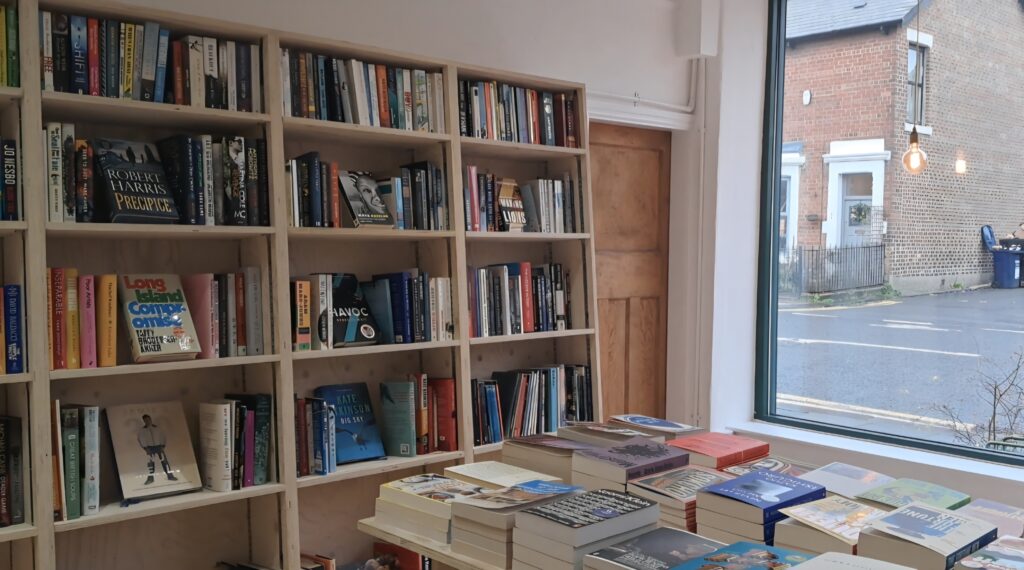
Another pro of being a local community bookshop is their ability to do personalised recommendations. They have lot of regulars and get to know their book preferences. This means that they are able to give tailored recommendations to each person. As Kate reminds me, in an independent bookshop you are able to “speak to people who love what they are selling”. They can also get book recommendation off people for ideas of what books to stock next. She loves the gratification when people come back saying that they enjoyed a book that she has recommended.
Statistics from the National Literacy Trust show that reading levels in children are at their lowest since 2005 when surveys were first carried out. Just 1 in 3 children aged 8-18 reported that they enjoy reading, with only 1 in 5 reading daily. This falls even lower with age, with 40% of the British population reporting that they hadn’t read or listened to a book in the last year according to YouGov in Jan 2025.
Kate believes that reading, and a love for books is essential, especially in children. Especially in the current monotonous media landscape where social media content is fed to you via an algorithm. Reading gives children a screen free activity to do by themselves, as well as helping them work out what they are passionate about. Obviously you have to find and choose books yourself, which can be really useful for figuring out what you are actually interested in without other influencing factors.
Reading is also great as it can “transport you to whole other places” whether real or fictional. Reading can help broaden your understanding of other cultures and ways of life. Kate likes to read translated fiction which she says has helped her learn more about other places. In terms of fictional worlds, it is a brilliant form of escapism, perhaps better than film or TV, as reading requires focus to be fully absorbed in it, so you are less likely to get distracted.
Reading is also incredibly good for your brain. Healthline reports on a 2020 study involving brain MRIs which showed that people who read have more grey matter in their left temporal cortex. This grey matter plays an important role in cognitive functioning. There are also studies that link reading to increased empathy and improved mental functioning in older adults.
These studies highlight the value of reading, whether fiction or non-fiction, and by extension, the importance of bookshops that can nurture a passion for it. If you are interested to read more on this subject, the Booksellers Association have a 2024 report on the cultural value that bookshops add to their communities.
However, independent bookshops rely on you as much as you rely on them. Without loyal customers they struggle to stay afloat financially. Therefore, it is so important to support where you can and try to refrain from buying from huge retailers when possible. Listen to the audio clip to find out why people think independent bookshops are important.
Let me know what you think of independent bookshops in the comments below!