Newcastle University budgeted for international students who never arrived, leaving a shortfall of around £35 million. Two years on, staff say the damage did not stop at the university gates.
This story is told as a audio report. Nick Hillman of the Higher Education Policy Institute explains why international student numbers fell across the UK, while the union branch chairs at Newcastle and Northumbria describe what the cuts have meant on the ground.
In September 2024, Newcastle University told staff it was facing a shortfall of around £35 million. No funding had been withdrawn. The university had planned its budget around international students who did not arrive.
Closing that gap cost around 300 jobs and led to 44 days of strike action.
A national problem, felt hardest here
Nick Hillman OBE, Director of the Higher Education Policy Institute, said the fall hit the whole sector, but not evenly.
“International students are down across the board, but it’s universities like Newcastle that are the most affected.”
Nick Hillman OBE, Director, Higher Education Policy Institute

Nick Hillman OBE, Director of the Higher Education Policy Institute. (Image Courtesy: HEPI)
Asked how much of the drop was down to visa rules and how much to competition from other countries, he was clear.
“I think it’s almost entirely the first one. The changes to visa rules.”
Nick Hillman OBE, Director, Higher Education Policy Institute
The change he pointed to came in January 2024, when the previous government stopped most one-year taught master’s students bringing dependants. HESA figures show international enrolments fell 5.9 per cent in 2024/25 to 697,365, driven mainly by a drop in postgraduate taught numbers, the very courses universities like Newcastle rely on most.
Hillman ruled out the idea that students are simply going elsewhere, pointing out that the United States, Australia and Canada were all tightening their rules at the same time.
He also warned that cuts made to plug the gap carry a long tail.
“Good quality education of the sort that Newcastle offers costs a lot of money to deliver, and if Newcastle has less money to deliver it, it’s likely not to be as good.”
Nick Hillman OBE, Director, Higher Education Policy Institute
What it cost inside the university
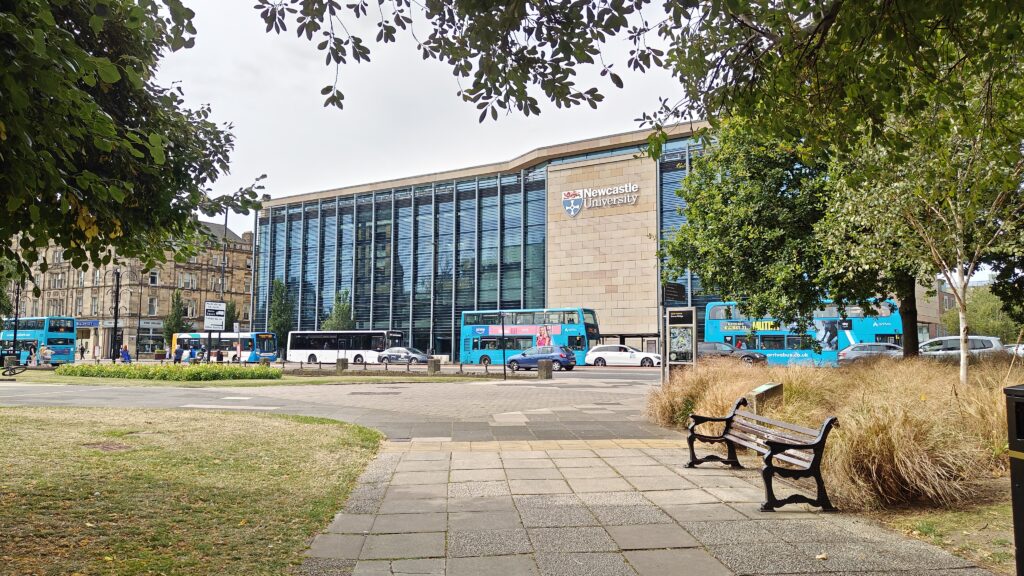
Matt Perry, branch chair of Newcastle University UCU, said the union never accepted that the cuts were necessary. The branch argued the university had strong cash reserves and a good borrowing profile, and could have weathered the shortfall without cutting courses and jobs. The university has said it remains in a sound financial position.
After 44 days of action, the branch secured an agreement that nobody would be made compulsorily redundant.
“Although there were job losses, nobody went on compulsory grounds. That was a big success, and that’s not happening at many universities.”
Matt Perry, Branch Chair, Newcastle University UCU

But Perry said the win was local, and the problem is not.
“We shifted the context at Newcastle. We didn’t shift the UK-wide context, and therefore those pressures are still there.”
Matt Perry, Branch Chair, Newcastle University UCU
He argued the deeper issue is that universities have been using international student fees to cross-subsidise what government funding does not cover, calling it an Achilles heel for the sector.
Two universities, one city
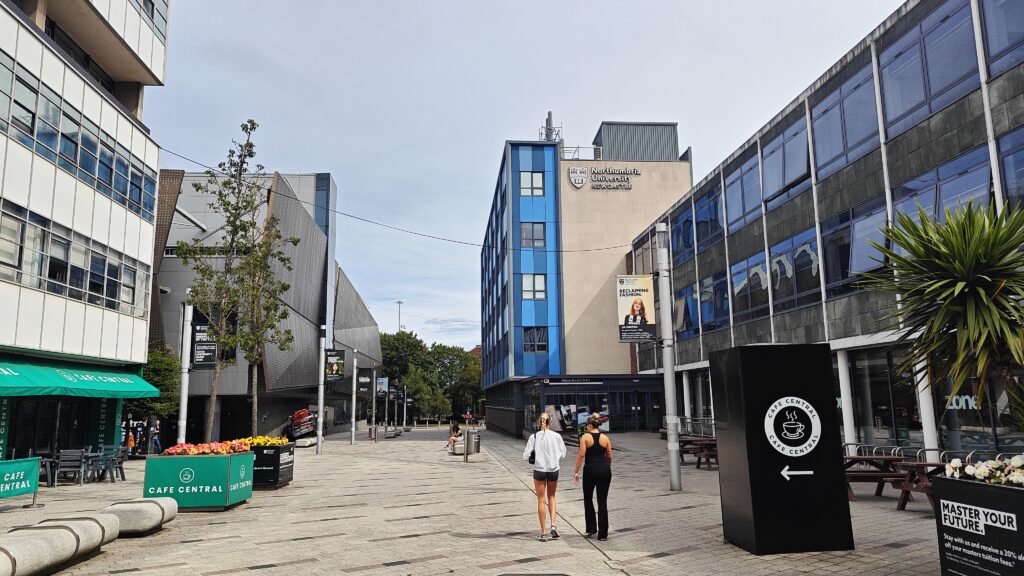
Northumbria University’s city campus. It has also cut staff costs, blaming a fall in students from overseas. (Original Picture: Ameya Edvankar)
Newcastle is not the only university in the city under pressure. Northumbria sought a further £12.5 million in staff cost savings, with its vice chancellor pointing to a sudden drop in students from Nigeria and elsewhere. Staff there have since balloted for industrial action.
Adam Hansen, branch chair of Northumbria University UCU, said the effects reach well past the two campuses.
“The decline in international students has a direct impact on the economic well-being of the people in this region. If there are fewer staff, there are fewer well-paid jobs, and well-paid jobs is something this region really needs.”
Adam Hansen, Branch Chair, Northumbria University UCU

Adam Hansen, branch chair of Northumbria University UCU. (Image Courtesy: Northumbria University)
That money reaches well beyond the lecture halls. Research by HEPI and London Economics puts the contribution of international students in Newcastle upon Tyne Central and West, the constituency both universities sit in, among the highest per resident anywhere in the country.
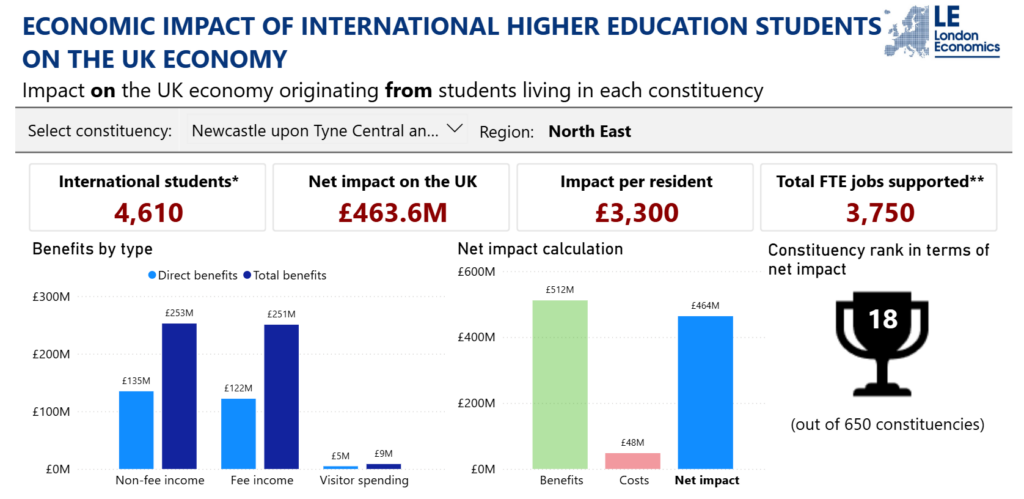
International students in Newcastle upon Tyne Central and West contribute an estimated £464 million, around £3,300 for every resident of the constituency. (Image Courtesy: HEPI)
Asked to sum up the situation for the people of Newcastle, Hansen did not hesitate.
“Inhibiting international students coming to the city is a self-inflicted wound. It doesn’t need to happen, and it’s bad for students, it’s bad for staff, and it’s bad for the region.”
Adam Hansen, Branch Chair, Northumbria University UCU
Next in this series: what happens when 18 months is all you get
From next year the graduate route visa drops from two years to 18 months. Hillman, who has written about how few employers even understand the route, said the timing makes little sense, because most new staff only begin proving their worth after the first six to twelve months.
For the students already here, that is not a policy debate. It is a countdown.
Read the next story in this series on what those six lost months really mean.
About the author
Ameya Edvankar is a multimedia journalism student at Newcastle University, reporting on the city and the people. Read more about him here.
Follow more of his work on Instagram at @ameyaedvankar and @ameya_frontrow.