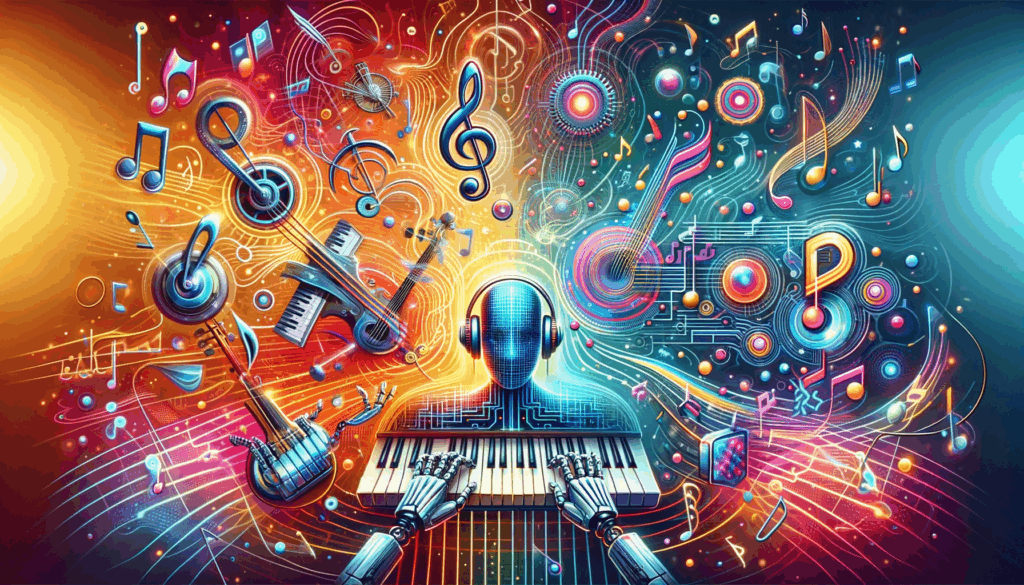
The blending of Artificial Intelligence (AI) and music is rapidly transforming the soundscape of the 21st century. Tools like Suno AI and Udio, which debuted in 2024, can now generate full musical tracks, lyrics, instrumentals, and even vocals, which are based on simple text prompts. As the line between human-made and machine-generated music blurs, a new question emerges: Is AI enhancing artistic creativity, or is it replacing it altogether?
A New Definition of Creativity?
To examine this cultural turning point, Dr. Adam Behr, Head of Music Department at Newcastle University and a researcher in music, technology, and policy, shared his insights.
“Creativity is hard to pin down. It’s not just about producing something new, but about who produces it and why,” Behr notes.
According to him, AI tools don’t necessarily expand the definition of creativity but provide alternative tools to achieve creative outputs.
Drawing comparisons to the 1997 case of The Verve’s “Bittersweet Symphony,” where the band lost rights over a sample from a Rolling Stones composition, Behr suggests that authorship and ownership have always been murky. With AI, these lines are now tangled than ever, particularly when machines produce music based on datasets of millions of human-created songs.
Enhancing or Replacing? Context Matters
When asked whether AI is enhancing or replacing creativity, Behr gave a balanced view:
“Not replacing creativity, yet. But at some point, it replaces some musical production jobs.”
For instance, AI can now generate background music for ads, YouTube content, or TikTok in seconds. Previously, this work would have gone to freelance composers or small studios.
“If you need 30 seconds of nondescript, mid-tempo funk with no lyrics, why hire a human? In that way, AI is replacing Functionality, instead of artistry.”
Nevertheless, Dr. Behr also perceives AI as a creativity enhancer for artists who use it experimentally, with quick trails, intertwining styles, and creating structure templates to inspire original compositions.
This kind of dualism is resonated by a 2024 Music Ally survey, which discovered that around 20% of independent artists have used AI music tools, often to experiment, deliberate, or create early drafts instead of release-ready tracks.
At the wider industry level, a 2024 report by CVL Economics, commissioned by several industry group such as the Animation Guild and the Human Artistry Campaign, estimates that 204,000 entertainment jobs across the U.S., including roles in music, are at risk of disruption by AI over the next three years.
In the meantime, TechRadar industry analysis has estimated that over 20,000 AI-generated songs are uploaded to Spotify every day, raising questions about content overflow and diminishing opportunities for emerging human artists.
Such studies provide an account of a fast-evolving creative landscape, where challenge is no longer in the manner in which AI is used, but why and by whom.
Ethics, Voice Cloning, and Copyright Crisis
The use of AI to mimic the voices of famous artists is perhaps the most controversial topic in this discussion. Trends such as an AI-cloned voices of Billie Eilish or Drake have spread quickly on platforms like TikTok and SoundCloud.
Dr. Behr says, “It’s fun on the surface, but it risks eroding trust. And legally, it’s a mess.”
He explains that artists with a commercial voice identity, for example, Ed Sheeran, can often pursue legal action, but everyday people can’t. “How do you prove voice ownership in a court of law when your voice changes with age, illness, or tone?”
This is echoed in a 2024 paper published in The IP Press, which noted that 91% of copyright frameworks globally still do not account for AI-generated vocal cloning. As the author writes, “We are dealing with 20th-century laws in a 21st-century reality.”
There’s also concern about data training. If AI is trained on 10 million songs, how can artists whose work contributed to the dataset be compensated?
“It’s a black box. There’s no audit trail,” says Behr.
Music Education and Ethical AI Use
As an educator, Behr emphasizes the importance of students learning AI responsibly.
“It’s not about banning it. It’s about using it ethically and creatively,” Dr. Adam Behr says.
In his view, students should be taught to use AI as a support system, such as testing ideas, structuring compositions, or remixing motifs, rather than as a shortcut to bypass learning.
“If you’re studying music for three years and just letting AI do the work, you’re not building real skills. And when the AI fails or evolves, you’ll be left behind.”
This approach links with a 2025 study in Arts Education Policy Review, which recommends integrating generative AI into music curricula through four key pillars:
- Enhancing AI literacy
- Developing collaborative assessment frameworks
- Ensuring equitable access to tools
- Supporting teacher professional development
All aimed at guiding responsible, creative AI use in education.
The Future: Human + AI or Human vs. AI?
What does the future look like?
“I think we’ll see both paths. AI-generated music will become widespread. But there will also be a renewed premium on human-only creativity, concerts, handmade compositions, and analog sounds,” says Behr.
He compares it to the survival of theatre in the age of streaming.
“People will crave what’s real, what’s flawed, what’s human.”
There’s even a possibility of an ‘AI vs. Human’ content economy. As Wired noted in its 2024 feature “Music Can Thrive in the AI Era”, the rapid rise of AI-generated music could “foment a new appreciation for classical human-made relics”, turning authentic, analog, or human-composed music into a luxury experience, sold through exclusive vinyl, intimate live shows, or NFT-backed proof of human authorship.
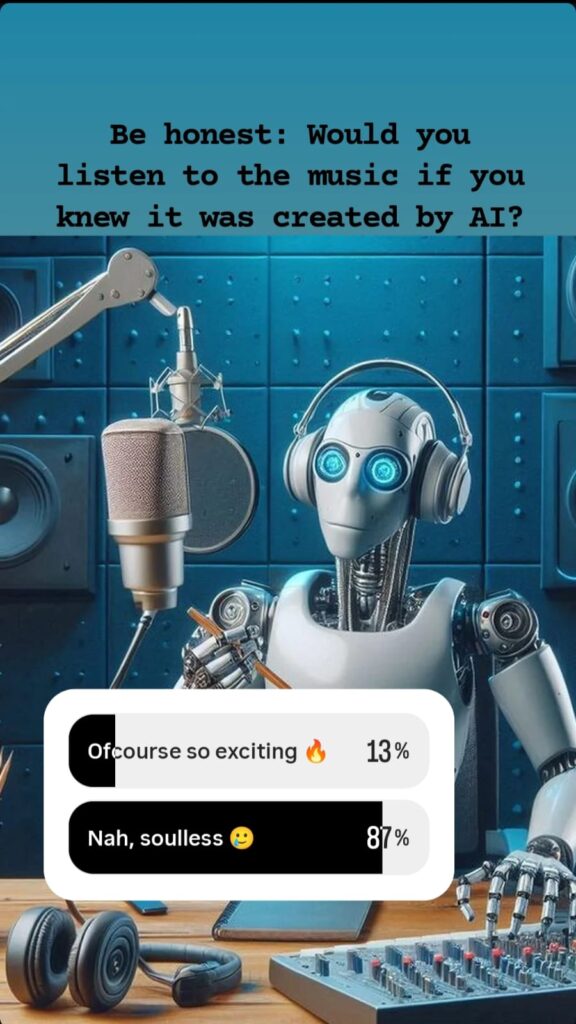
And when I asked my followers whether they prefer AI-generated music or Human-made music, 87% followers chose the human-made, whereas the other 13% chose AI-generated music.
Navigating a Tipping Point
AI is not inherently the antagonist of creativity. AI is the reflection of our choices, tools, and values. At the moment when the music industry stands at a crossroads, musicians must decide whether to embrace AI as a co-creator or fear it as a replacement.
The most powerful art of tomorrow may come from those who know when to use AI and when to turn it off.